Soft Costs: How Custom Home Design, Permit, and Builder Fees Add Up in the PNW
Are you planning to build or remodel a home and wondering how much it costs to hire someone to design and build your project? This guide breaks down typical construction and design fees, explains the difference between hard costs and soft costs, and shares practical tips to help you get the most value from your budget.
Curious about construction costs? See our article on the Cost to Build a Custom Home in Kitsap County.
Hard Costs versus Soft Costs
Hard costs build the house. Soft costs make it possible.
Hard Costs
Hard costs are the direct costs of construction, the labor and materials required to physically build the house.
This includes items such as:
Site work and excavation
Structure, enclosure, and roofing
Windows, doors, and finishes
Mechanical, electrical, and plumbing systems
Hard costs are what you pay to build the home itself.
Soft Costs
Soft costs are the professional services and approvals required to design, permit, and deliver the project.
This typically includes:
Architectural and engineering services
Surveys and geotechnical reports
Permits and regulatory fees
Specialty consultants, as needed
Soft costs don’t result in a physical building element, but they are essential to a well-coordinated and buildable project.
General Contractor Fees — Are they a Soft Cost or Hard Cost?
Where do General Contractor (GC) costs fall? If you hire a GC, they will charge you for three costs beyond labor and materials: general conditions, contractor overhead/profit, and sales tax. While these costs do not stay with you once the project is completed, they are still typically considered hard costs as they occur during construction.
General Conditions
The cost of running the construction site. This includes project management, supervision, temporary utilities, site safety, dumpsters, scheduling, and coordination of trades.Contractor Overhead & Profit
The contractor’s cost of operating their business and assuming construction risk, pays for their office staff, insurance, bonding, tools, and financial responsibility for delivering the work.Sales Tax on Construction
Sales tax applied to labor and/or materials (varies by jurisdiction) and is part of the total cost of construction.
Summary of Hard Costs and Soft Costs
Hard Costs: Materials & Labor, General Contractor Fees (General Conditions, Overhead & Profit), Sales Tax
Soft Costs: The Architect’s Fee, Engineer Fees, Consultant Fees, and Permits
Note: These examples do not include land acquisition, financing fees, legal costs, or property taxes.
What are Builder fees?
General Contractors costs add nearly 40% to the cost of labor and materials — a common mark-up is 15%.
If you self-manage your home construction project, you pay for the labor and materials required to complete the work. We will refer to this as Labor and Material Costs.
When you hire a General Contractor, they take on responsibility for managing the construction process. Every builder structures their fees differently, but here is a fairly common set-up for builders in the Puget Sound area. In addition to labor and materials, the contractor charges fees for General Conditions and Mark-Up. In Washington State, General Contractors are also required to collect Sales Tax on their billings.
General Conditions
General Conditions typically range from 15–35% of construction costs, with around 20% being common. These costs cover supervision, construction management, and items needed to complete the work that do not remain once construction is finished, such as dumpsters, temporary fencing, and portable toilets. People costs (site supervisor, project manager) are usually the largest line items.
Mark-Up
Mark-up is typically around 15% and represents the contractor’s profit on the project. Builders apply mark-up in different ways: some apply it to every line item in the budget, others only to select items, and some use different mark-ups for different components (for example, windows versus lumber).
Sales Tax
Whether you build yourself or have a General Contractor build the project, you also need to pay Sales Tax. If you self manage construction, you pay Sales Tax on Labor and Materials. If you hire a General Contractor, Sales tax is applied to everything the general contractor bills you for; Sales Tax even applies to the General Conditions and Mark-Up as that is part of the total contract price.
In Washington State, sales tax is generally around 10% though rates vary by jurisdiction.
How General Contractors Costs add up.
Construction Cost Breakdown:
Labor and Material Costs
General Conditions (plus 20%)
Mark-Up (plus 15%)
= Pre-TaxConstruction Cost
Pre-Tax Construction Cost (plus 10%)
Sales Tax
= Post-TaxConstruction Cost
Since you, the homeowner, will be paying for the post-tax amount, this is the bottom line you care about.
Pro Tip: ask your builder if they are referring to pre-tax or post-tax amounts when reviewing bids.
What are Design Fees?
Architects and Engineers get paid Design Fees for their services — for most projects this is in the range of 6-15% of hard costs.
For Architects, this work includes design, code research, consultant coordination, specifications, and permit processing. Hiring an architect ensures a thoughtfully planned, functional, and code-compliant home that is both beautiful and practical.
Basic Architectural Services include:
Schematic Design
Big-picture concepts, preliminary sketches, and overall design ideas
Design Development
Refined drawings, product selection, and coordination with consultants
Construction Document
Detailed drawings and specifications for permitting and construction
Construction Contract Administration
Support and guidance throughout the construction phase
How much are Architect’s Design Fees?
There are several ways to determine architectural fees, including hourly billing, a fixed fee, or a percentage of construction cost. At Studio Kamppari, we bill hourly, but we encourage clients to think about total design fees in terms of a percentage of construction cost to help with early budgeting.
Design fees vary based on project complexity. A simple project—such as a box-shaped warehouse on a flat site—typically requires significantly less design effort than a complex project, like a custom home on a sloped lot.
Below is a chart showing typical design fees expressed as a percentage of construction costs. Every project and every Architect is different — a star Architect’s like Tom Kundig can charge much higher rates — but it is helpful to know what is common for many projects here in the Puget Sound area.
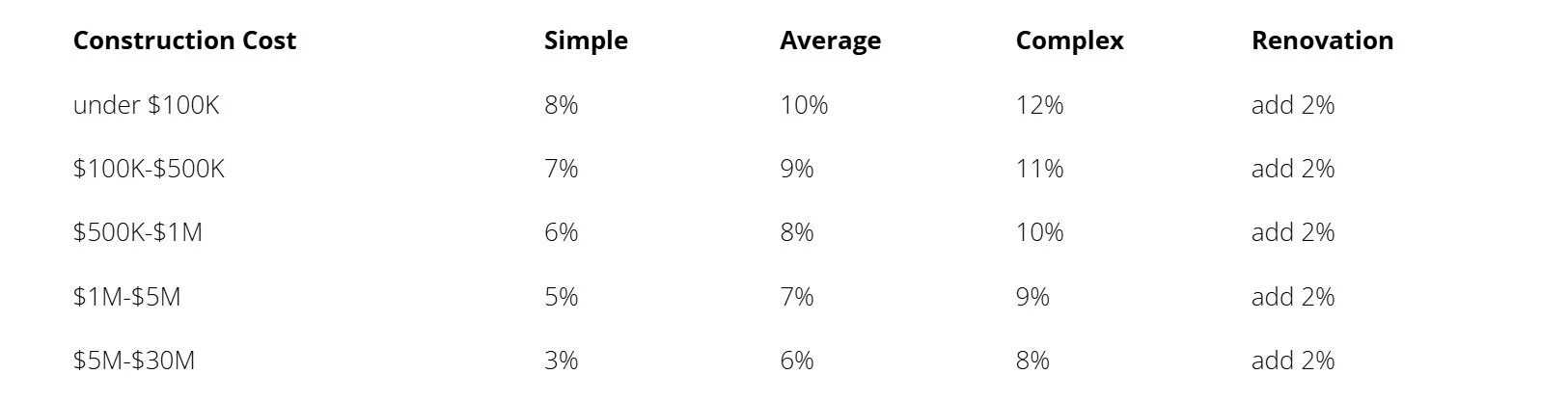
Why would a renovation cost more design fee? Renovation projects require careful documentation and investigation of existing conditions. It takes time to understand what is already in place and how it can be changed or added to. From an architect’s perspective, working within existing conditions is often more complex than designing new construction, as it requires adapting to constraints and unknowns.
Why is a custom home considered complex? A custom home is designed specifically for an individual or family. This level of personalization requires additional time to thoughtfully resolve materials, style, program, and spatial layout. Designing a home around the needs, preferences, and daily rhythms of a specific client inherently adds complexity—and results in a more refined, meaningful outcome.
In addition to the Architect, who else is paid Design Fees?
The architect serves as the lead designer and primary coordinator for the project, but most projects also require input from additional engineers and consultants to support specific technical aspects of the design.
Common Core Design Team Consultants include:
Structural Engineer — most common on every project, often about 2% to 3% of hard costs
Civil Engineer
MEPF: Mechanical, Electrical, Plumbing and Fire (typically only on Commercial Projects)
Many specialized consultants may be involved in a project, including landscape designers, acousticians, septic system designers, and building envelope experts. Some consultants contribute feedback that is incorporated into the construction documents or provide drawings directly. Other consultants produce reports or surveys required by the permitting authority, such as land surveyors, geotechnical engineers, and wetlands or shoreline biologists. In general, consultant fees can be roughly one-third of the architect’s fee.
What are typical fees for the other common professional services in Kitsap County?
If you are building on a flat lot with no critical areas, you only need your core design team. But, if your project requires a septic system, you are near a steep slope or wetland, continue reading. Here are the usual suspects and fees for those:
Common Site/Environmental Consultants include:
Geotechnical
If your site has an erosion hazard, a baseline mini report can cost $1,600 to $2,600
If you need a Geological Assessment (identify hazards and site suitability, stormwater drainage waivers, land-use review), these can cost $3,500 to $4,000
If you need a Geotech Report (engineering guidance for the design and construction of foundations and earthwork, involves soil borings, used for building permit) these can be $5,300 to $9,000. If significant drilling is required, you can expect in the realm of $15K-$16K.
Septic Design
This is for the design of the system, required when you submit for permit, this can be in the realm of $3,000 to $6,000
Biologist / Wetland Consultant
If you need a mitigation plan for shorelines buffers or wetlands, you can expect those fees to be in the realm of $3,000 to $6,000.
Survey
Depending on the contents of the survey and size of the lot, this can be in the realm of $2,000 - $6,000; this would be for a survey with topography contours, utilities, property corners, existing structures, big trees, lot corners.
For a complete budget, make sure to include:
A. Design Fees
Architecture
Structural
Civil
MEP
B. Site & Environmental / Due Diligence
Geotechnical
Septic Design
Biologist / Wetland Consultant
Survey
What are Permit Fees?
In Kitsap County, your basic building permit fees can be calculated if you know your area of enclosed heated space and area of garage space. Permit fees pay for the time it takes the county to review your project for code compliance.
You can go here for Kitsap County 2026 Permit Fee Schedule and refer to ICC Building Valuation Data which in Feb 2026 Type VB showed $175.92 / SF for heated space, $71.07 / SF for garage space, and $31.50 / SF for unfinished basement space. That value is then be multiplied by a Permit Fee Multiplier (check with your local jurisdiction, but in Kitsap it was 0.0224 for a Single Family Residence) for the total permit fee.
Pro Tip: Check with your local jurisdiction for how permit fees are calculated!
In addition to building permit fees, new construction projects will also have an impact fee. An impact fee is a government-required fee charged when new construction places additional demand on public infrastructure.
These fees help fund community systems such as:
Roads and traffic improvements
Schools and parks
Water, sewer, and stormwater systems
Fire, police, and other public services
In Kitsap County, you can expect your impact fee to be about $8,000.
Here are some real world permit fee examples from the city of Port Orchard in December 2025 and January 2026
Single Family Residence: $19,5234.59
Single Family Residence: $25,296.55
Single Family Residence: $22,141.01
If your project requires additional permits, such as shoreline or conditional use permits, overall permit costs can increase significantly. Because these permits involve complex regulations, your project may benefit from a Pre-Submittal Conference, which is a meeting with the local jurisdiction typically for a few hundred dollars where your project is reviewed in advance to identify any special requirements or rules that may apply.
Lastly, if your project requires multiple rounds of revisions to get a successful permit submission, you may encounter additional fees.
Pro Tip: In Kitsap County you need separate permits for each structure you are building — separate permits for the main house and detached garage.
Pro Tips for how to get more for less
If your goal is to spend less on soft costs and more on the materials and labor that actually go into your project, the key is to reduce the amount of time spent managing the project. You cannot get anything for free, but there are strategies to shift your budget toward hard costs.
1. Fixed-Fee Budget with Your Builder
What it is: You agree on a set price for the builder to complete the work.
Pros:
Potentially lower overall cost, since the builder doesn’t need to charge for every hour managing receipts or subcontractors.
Cons:
Less transparency into actual line-item costs.
Less control over materials or methods.
Builders may be incentivized to meet only the minimum contract requirements, which can affect quality.
Tip: If high quality is a priority, a time-and-materials contract can offer more control. You pay more for soft costs, but with this model a builder’s is less incentivized to cut corners.
2. Streamlined Design Approach
What it is: Ask your Architect to create a design based on your minimum requirements — and you let your architect design everything.
Pros:
Reduces the Architect’s fee to managing owner design options, lowering your soft costs.
Cons:
Requires a high level of trust in your designer.
Fewer opportunities for personal input or changes during the design process.
Bottom line: The most effective way to allocate more of your budget to hard costs is to reduce the hours spent on management and decision-making, while making careful choices about contract type and design approach. As an architect, I love bringing people’s dreams to life. I also understand that budgets can sometimes get in the way. If you trust your architect’s vision, set some clear guidelines, and then let them work their magic.
Transparency and a Focus on High-Quality, the Studio Kamppari Model
We are here to help you build your custom home. Contact Us to set up an introductory call.
Related Articles:
Design Resources:
Our design workbook helps homeowners discover what matters most before committing to a design. A link to our book “Before the Plan: Start with Words” and 1-page Design Guides can be found here.